Where Fear Actually Comes From.
Why fear is rarely about what’s truly happening now.
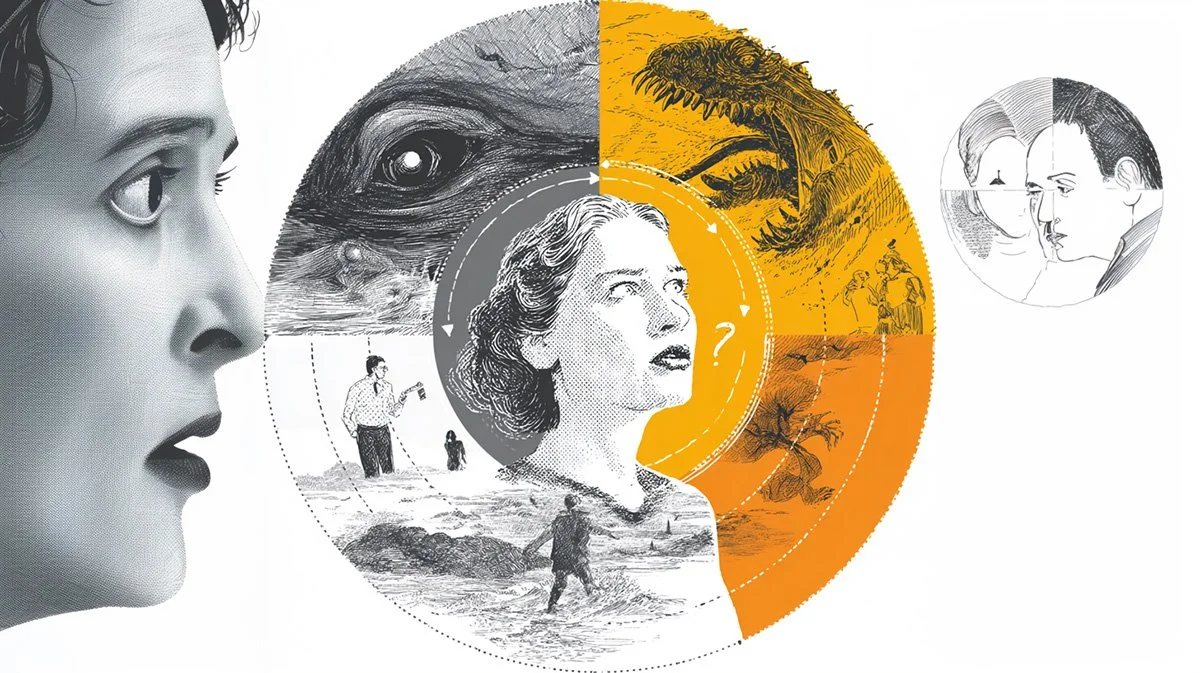
Fear is one of the most misunderstood human experiences.
Most people believe fear is caused by external danger — a situation, a person, an event, or uncertainty about the future.
But when we look closely, something surprising becomes clear:
Fear is almost never caused by what is happening right now.
Fear arises when the mind places interpretation — often shaped by past stories about ourselves — onto the present event.
A Simple Observation
Right now, in this moment, notice what is actually here.
There may be:
• sounds
• bodily sensations
• visual impressions
• thoughts appearing and disappearing
Unless there is immediate physical danger, fear is usually not present in this raw experience itself.
Fear appears when attention shifts away from what is happening and becomes absorbed in thoughts about what is happening.
In other words, we are no longer present with the unfolding event — we are present with the mind’s interpretation of it.
A Subtle but Crucial Assumption
This interpretation is almost always shaped by:
• past conditioning
• memory
• learned beliefs
• personal history
And it usually begins with a thought about “me.”
“This is happening to me.”
“I am at risk.”
“I might lose something.”
“I could be hurt.”
But this raises an important question:
Does the thought “I” accurately represent what we actually are — or is it an unexamined assumption?
Without referring to memory or imagination, can a separate “me” be found apart from the experience itself?
Or is there simply experience happening, with the idea of an individual self added afterward, with a thought “I”?
When the mind assumes there is a separate “someone” inside the experience, fear naturally arises to protect that imagined center.
But when this assumption is gently questioned, fear often softens — not because life changed, but because the reference point fear depended on is no longer found.
Not because it disappeared — but because it was never actually there in the way it was assumed.
Many of our articles and free apps are designed to help clarify this process of discovery further — through direct observation rather than belief.
What Fear Is Really Made Of
Fear is constructed from two primary ingredients:
1. Memory — recalling past pain or threat
2. Imagination — projecting a future that hasn’t happened
The body reacts as if the remembered past or imagined future is occurring right now.
But it isn’t.
This is why fear can feel so real — even when nothing dangerous is actually happening.
Why This Matters
If fear were caused by reality itself, it would be unavoidable.
But fear:
• disappears when attention returns to the present
• fades when imagined futures are questioned
• weakens when thoughts are seen as thoughts — not facts
Reality doesn’t need to change.
Only the story about reality does.
Fear Feels Urgent — But It Isn’t Accurate
Fear has a real biological function:
to protect the body from immediate danger.
For a moment, notice any sense of fear or unease.
Then ask gently:
Is this fear coming from what is happening right now?
Or from a thought about what happened in the past or might happen in the future?
Without trying to remove fear, bring attention back to:
the room
the body
present sensations
and notice whether the experience and the one experiencing it are actually separate
Notice what happens to fear
when it is no longer fed by thought and imagination.
The Deeper Insight
Fear survives on time — on past and future.
But in direct experience, the present moment is always intact.
When attention rests here, fear loses its foundation.
The Implication
Freedom from fear does not come from:
• controlling life
• fixing the world
• eliminating uncertainty
It comes from seeing clearly what fear is — and what it isn’t.
When misunderstanding ends, calm returns naturally.
A Final Note
Our free apps, Mind Detox and Peace Booster Android and IOS, are designed to help explore fear in this way —
not by suppressing it, but by understanding the assumptions that sustain it.
Fear doesn’t need to be defeated.
It needs to be understood.